How to Export WordPress Form Entries to Excel and CSV (5 Ways)
The volunteer coordinator needs this week’s sign-ups, your bookkeeper wants last month’s orders, and a client keeps asking for “just a spreadsheet” of their leads. All of it is sitting right there in WordPress, and only an administrator can see it. So how do you export WordPress form entries for people you’d never hand an admin login?
You don’t, so you become the relay. Log in, export, attach, email, and do it all again next week when they ask. Then the one time you do pull the file, the entries from this morning seem to be missing, and now you’re wondering what else didn’t make it.
Yes, it’s a chore. But it’s one you can stop doing by hand. Below are five ways to get your form entries out of WordPress and into the right hands, starting with a free CSV you can send in three steps, and none of them means handing out an admin login.
What you’ll need
- Ninja Forms (free; method 1 needs nothing else)
- Excel Export add-on (method 2 only)
You’ll also need to be logged in as an Administrator. Out of the box, only Administrators can open Submissions in Ninja Forms.
Export WordPress form entries 5 ways, depending on who needs them
Each of these exports is the answer for a different person. The coordinator who wants a spreadsheet gets a CSV or an Excel file, a contractor gets a PDF, a team gets a live sheet, and the weekly report shows up without you. The first two take a few minutes, and we’ll walk through both step by step; the other three hand you off to the posts that teach them.
Quick comparison: who needs the entries, and which export fits
Find the person who’s asking, then read across.
| Who needs the entries | Method | What they get | Requires |
|---|---|---|---|
| Anyone with a spreadsheet app | CSV | A .csv file of your form submissions | Ninja Forms (free) |
| A colleague who wants a file that opens ready to read | Excel | An .xlsx (or .xls) with only the rows and columns you chose | Excel Export add-on |
| A contractor or client who needs one record | A PDF of one submission | PDF Form Submission add-on | |
| A team that wants a live view | Google Sheets | New rows in a shared Google Sheets spreadsheet | Zapier add-on |
| Whoever gets the same report every week | Scheduled export | A CSV by email, Hourly, Daily or Weekly | Scheduled Submissions Export add-on |
1) Export submissions as a CSV file (free)
This is the one everybody already has. The CSV export is free in Ninja Forms, it opens in any spreadsheet app, and for most people it’s all they’ll ever ask you for. Three steps, no add-on.
We’ll use a wildlife sanctuary’s volunteer sign-up form as the example. The coordinator needs the entries, and the coordinator isn’t a WordPress admin.
1. Open the form’s entries under Ninja Forms > Submissions
In your WordPress admin sidebar, go to Ninja Forms > Submissions. Choose your form in Select Form, or type part of its name in Filter Forms. The table lists every entry, newest first.
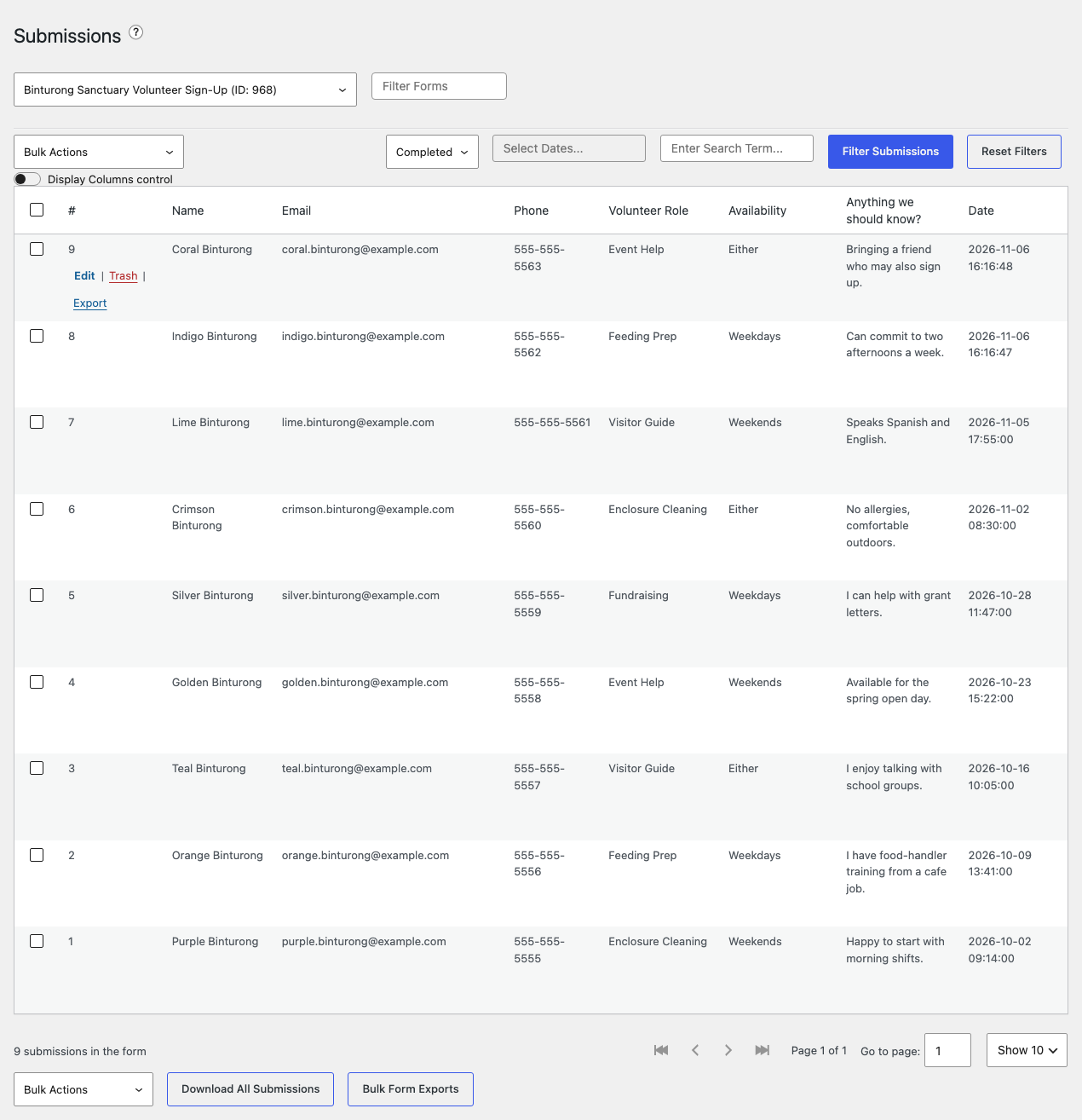
Glance at the Date column before you move on. It tells you whether you want everything or just a slice.
2. Pick the entries: all of them, a few, or a date range
Pick the control that matches what they asked for. Every one of them gives you a .csv file.
- All of them. Click Download All Submissions below the table. You get every entry on the form in one file, and it ignores the date and search filters, so skip this one when you only want this month.
- A few, or a date range. Tick the rows you want, choose Export in Bulk Actions, then click Export in the window that opens. For a date range, set Select Dates… and click Filter Submissions first, then tick the checkbox in the header row. That checkbox only ticks the rows on the page you’re looking at (10 by default), so raise Show at the bottom right first if your range is bigger. Enter Search Term… narrows the table by a word the same way.
- One entry. Hover the row and click its Export link.
- Whole forms, by date. Click Bulk Form Exports, choose one or more forms in Select Forms, pick one date or a start and end date, and click Export. Both end dates are included, today too, and you get one file per form.
For the sanctuary, Select Dates set to today shows exactly the two volunteers who signed up this morning. Tick them, export, and they’re both in the file.
3. Send the file; they won’t need a WordPress login
Your download is named nf-subs-[form ID].csv, so the sanctuary’s file is nf-subs-968.csv. Email it or drop it in a shared folder. It opens in Excel, Google Sheets or Numbers, and the coordinator never touches WordPress.
That’s all there is to it. The docs walk through exporting submissions control by control if you want the full tour.
A CSV gives them every entry and every column, every time. When they only want this week’s people and none of the phone numbers, that’s a job for an Excel export.
2) Export submissions as an Excel workbook for people who just want to open the file
The Excel Export add-on gives you a real .xlsx workbook with a frozen header row, holding only the entries and the columns you choose. You still download it and send it, same as the CSV.
The add-on needs the ZipArchive PHP module on your server; not sure you have it? Ask your host (the Excel Export docs say the same).
1. Choose the form on the Excel Export page
Go to Ninja Forms > Excel Export and pick your form in Select a form. The page always opens on the first form in your list, so check this dropdown every time. The boxes below reload for the form you picked.
2. Filter the entries and choose the columns
This is where Excel earns its keep. In Filter Submissions, pick a field, a condition and a value. Choose Submission date and the value box turns into a date picker.
Use = for a single day. Use ≥ or ≤ for a range, and both include the day you name. Click + to add another row; an entry has to match every row to make the file.
For the sanctuary, Submission date ≥ November 2 gives the coordinator this week’s four volunteers and nobody else.
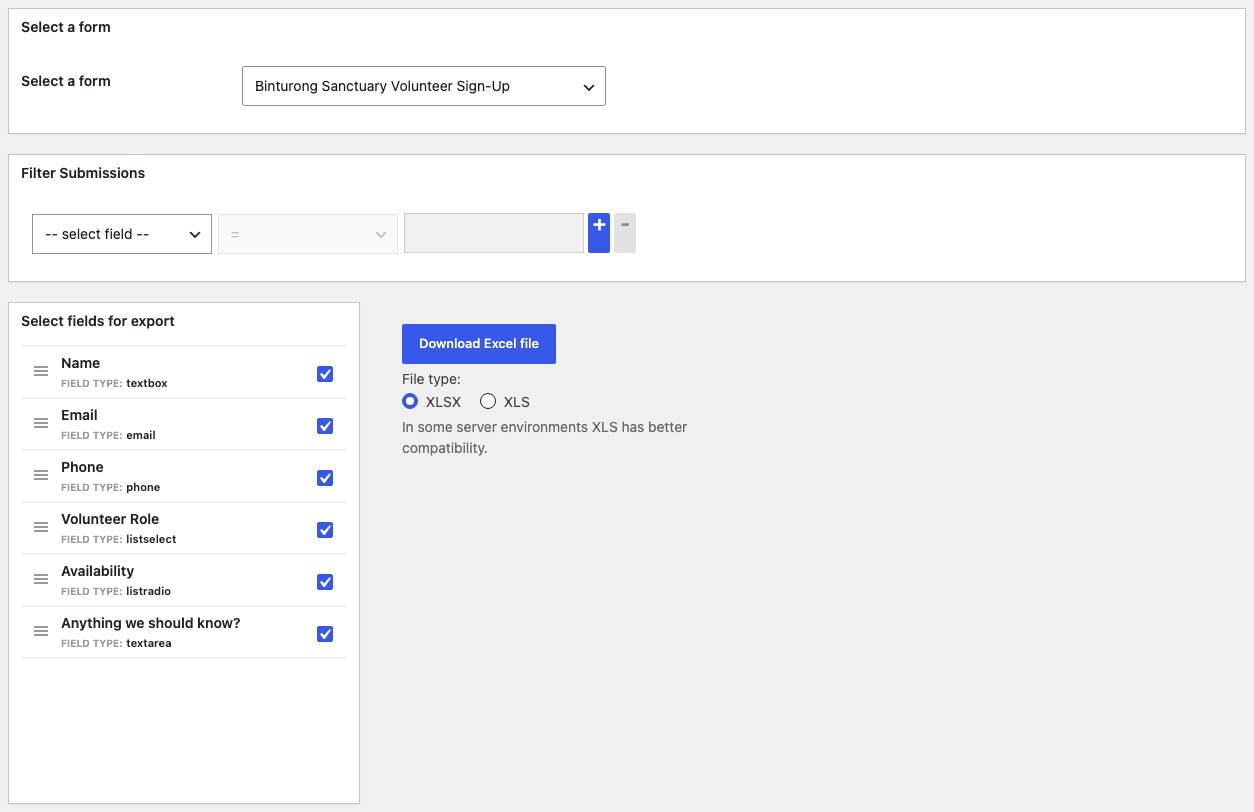
Next, Select fields for export. Untick a field to drop its column, and drag a field to move it. Untick Phone, and the coordinator’s file has no phone numbers in it.
The add-on remembers both choices for each form. That’s handy next month, and it’s also how a file comes up short. Last month’s filter is still sitting there, trimming this month’s entries.
So look at the Filter Submissions box before every download.
3. Download the workbook and send it
Leave File type on XLSX and click Download Excel file. (XLS is there too, if your server gets along better with the older format.)
The file is named after your form plus the date and time, like binturong-sanctuary-volunteer-sign-up_2026-11-06_162116.xlsx. Send it the same way you’d send the CSV. That’s it.
Not everyone wants a spreadsheet, though. Some people need exactly one entry, and they want it as a PDF.
3) Export one submission to PDF for a contractor or client
A contractor quoting one job doesn’t need your whole list. Neither does the client checking one application. They want that one entry as a PDF they can save or print.
The PDF Form Submission add-on makes a PDF of an entry, on demand from the submission itself or attached to an email. Each PDF holds a single submission, so the contractor sees only their job. You can turn form submissions into PDFs start to finish with our walkthrough.
And when it’s not one person but a whole team asking, stop sending files at all.
4) Send new submissions to Google Sheets for a team that wants a live view
The Zapier add-on adds each new entry as a row in a shared Google Sheets spreadsheet. After setup, nobody downloads anything. They open Google Sheets and the new sign-ups are already there.
Only entries submitted after your Zap is on make it over, so start the sheet with a one-time CSV from method 1. You’ll need a Zapier account, and you can connect WordPress forms to Google Sheets in five steps.
5) Schedule automatic exports by email, so nobody has to remember
Remember being the relay from the top? Scheduled exports are how you quit. The Scheduled Submissions Export add-on emails a CSV of your entries on its own, Hourly, Daily or Weekly.
For a report that goes out every Monday, it’s the one we’d pick. Here’s how to send a weekly digest of form submissions.
Rather they see the entries themselves? Give their role access, not an admin login
Can someone who isn’t an admin see form entries? Not out of the box. In Ninja Forms, only Administrators can see entries, and an Editor who tries gets “Sorry, you are not allowed to access this page.”
The User Management add-on changes that with its User Access panel, which gives a WordPress role view, or view and edit, rights on submissions.
Each right splits into Owner (entries that user submitted) and Others (all entries). Rights are set per role and cover every form, so give access to the role your coordinator already has. Nobody waits on you to export anything, and the admin login stays with you.
Give Ninja Forms a try today!
Ninja Forms is free! Optional premium features available with any membership.
What’s in the file they’ll open?
A CSV holds every field on the form, oldest entry first. An Excel file holds only the fields you ticked, newest first, with the header row frozen in place.
The CSV starts with # (the entry number) and Date Submitted, which is the date only, in your site’s date format. Every field follows by its label, in form order. Every value sits in quotes, so a comma in someone’s note won’t shift the columns. Here’s the sanctuary’s header row:
"#","Date Submitted","Name","Email","Phone","Volunteer Role","Availability","Anything we should know?"
There’s no choosing columns in the CSV. You get them all.
The Excel file has one sheet. ID and Submission date come first, then the fields you ticked, each under its Admin Label if you set one, otherwise its label.
The date is stored as text, like “November 6, 2026”, so sorting that column sorts it alphabetically. Sort by ID instead to put entries back in the order they came in.
Export missing entries? Check these first
When you export WordPress form entries and some are missing, they’re usually still there and something narrowed the export. Run down this list before anything else.
- Only the visible page was ticked. The header checkbox ticks the rows on screen and no more. Raise Show, or use Bulk Form Exports for a date range.
- An old filter is still saved. Open the Excel Export page, check Filter Submissions for that form, and clear anything you didn’t mean to keep.
- Store Submission was off when those entries came in. It’s on by default on new forms, but entries that were never stored can’t be exported. Open the form’s Emails & Actions tab and make sure the Store Submission action is on for the next ones.
- Your Submissions screen looks different. If the buttons named above aren’t there, Show Legacy Submissions Page is on. Turn it off under Ninja Forms > Settings > Advanced Settings.
Anything else you want to do with your entries starts in our WordPress form submissions guide.
Get your form entries to the people who need them, starting today
Like we said at the top, nobody should need an admin login to read a list of volunteers. Today you can export WordPress form entries to a free CSV and send it to the coordinator in three steps. When the need grows, there’s an Excel file, a PDF, a live sheet, a scheduled email or role access ready for whoever asks next.
Start with the CSV. It’s free, it’s already on your site, and for most people it’s all they’ll ever need.
So go send that file. Your coordinator’s waiting.
Try Ninja Forms Today
Always free, with premium features available through our memberships.
Great guide! It’s super helpful to see so many export options for form data. The clear breakdown makes it easy to pick the right tool for the job, whether it’s simple CSVs or more advanced integrations like Google Sheets. Really useful for managing form submissions efficiently!