How to Send WordPress Form Uploads to Dropbox
When someone submits a form on your WordPress site with an attached file, that file needs somewhere to live. By default, it lands in a folder on your own web server, right alongside your theme files and database backups. If your team already lives in Dropbox for everything else, that split creates its own kind of clutter: one system for your regular files, and a second, disconnected one for whatever your forms happen to collect.
Maybe you have noticed other WordPress form plugins advertise a Dropbox connection as a selling point, and you are wondering if you need a different tool to get it. You do not. Ninja Forms can route a form’s uploaded files straight into your Dropbox account the moment someone submits, with no third-party connector and no extra subscription to another service.
What you’ll need
To follow this walkthrough, you will need Ninja Forms (free) and the File Uploads add-on, which is included with memberships or available as a standalone add-on. You will also need a Dropbox account. The free tier works fine, since Ninja Forms creates its own dedicated app folder rather than asking for access to your whole Dropbox account.
If you have not built a file upload field yet, the complete guide to the File Upload field covers that groundwork first.
How to send WordPress form uploads to Dropbox with Ninja Forms
Ninja Forms sends form uploads to Dropbox through a built-in feature called External Storage, not a workaround or a third-party connector. You connect your Dropbox account once, site-wide, then add a single action to any form that tells Ninja Forms which uploaded files to route there. Files upload when the visitor submits the form, and Ninja Forms handles delivery to Dropbox from there.
Connect your WordPress site to Dropbox
The Dropbox connection lives at the plugin level, so you only need to set it up once no matter how many forms you want to use it on.
- In your WordPress dashboard, go to Ninja Forms, then File Uploads, then click the External Settings tab.
- In the Dropbox Settings section, click Connect to Dropbox.
- Log into Dropbox and approve access when prompted.
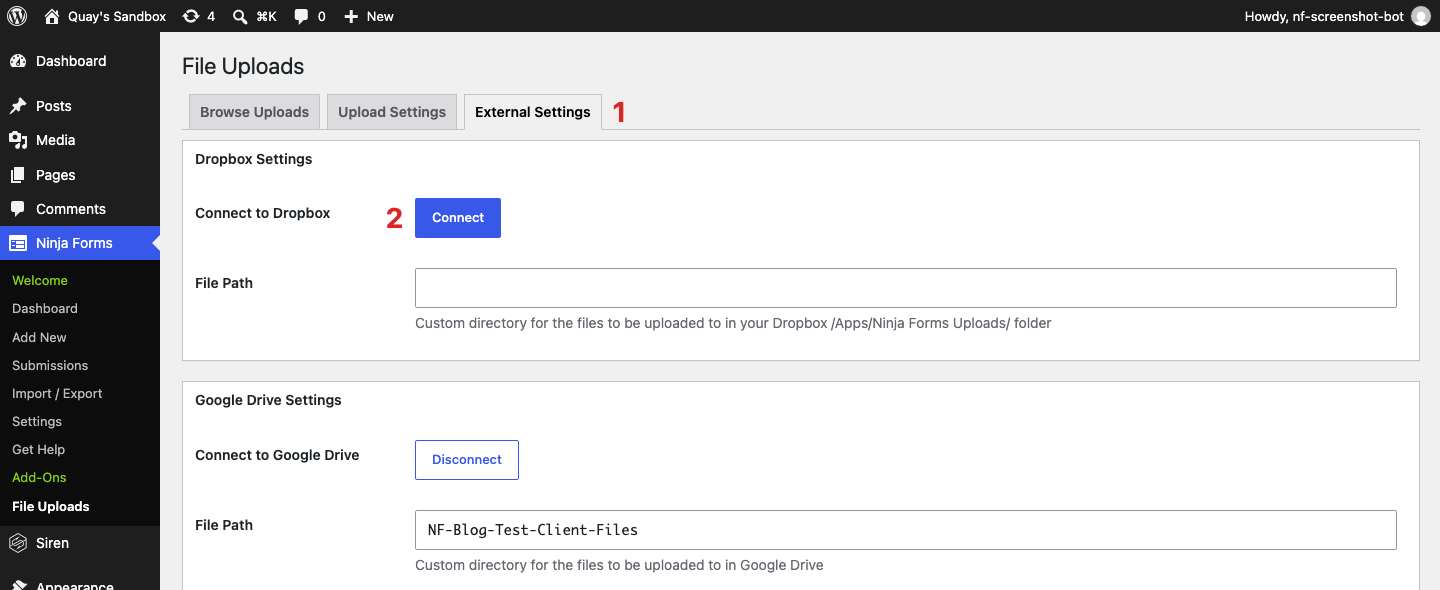
Dropbox does not hand Ninja Forms the keys to your entire account. The connection is scoped to a dedicated folder Dropbox creates for the app, called Apps, then Ninja Forms Uploads. That is worth knowing going in. It is a genuine privacy plus, since a plugin never gets a view into your existing folder structure, but it also means the File Path field in Dropbox Settings can only create a subfolder inside that app folder. It cannot point at an existing top-level Dropbox folder you already use for something else.
If you want submitted files sorted automatically into their own subfolder per submission, say one folder per applicant or per client, rather than one flat folder for everything, the guide to custom upload directories walks through building that with merge tags.
Tell Ninja Forms which uploads go to Dropbox
Connecting Dropbox does not change anything on its own. You still need to tell a specific form to use it.
- Open the form and click the Emails & Actions tab.
- Click the blue plus icon to open the Actions window.
- Add the External File Upload action.
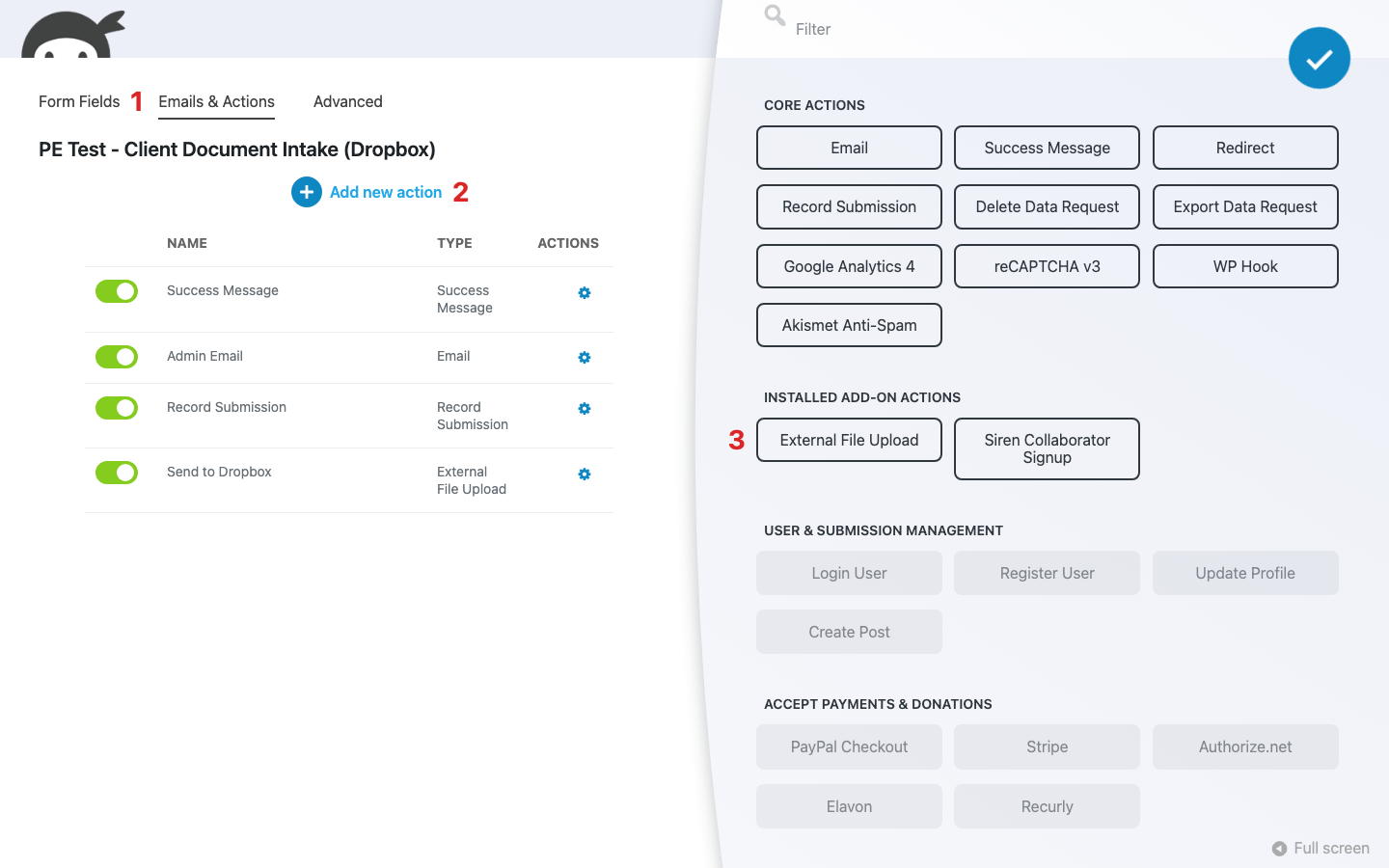
Inside that action, you will see a toggle for each connected storage service, listed next to your form’s file upload field. Turn on the toggle next to Dropbox to send that field’s uploads there. If you are uploading larger files, such as multi-page PDFs or zipped folders, turn on Background Upload as well. It processes the transfer after the visitor submits instead of making them wait while the file streams to Dropbox.
Decide whether to keep a local copy too
Before you turn anything off, confirm the Dropbox connection above is actually working with a real test submission. This matters because of what happens if it is not: turn off the local copy while a broken or disconnected Dropbox connection sits underneath it, and a submitted file’s link will fail to open, with no error shown to you or the person who submitted the form. Verify the connection first, then decide.
Each file upload field has its own Save to Server setting, on by default, in the field’s general settings. Turn it off once you trust the Dropbox connection, and Ninja Forms stops keeping a duplicate copy in your own server’s uploads folder once the Dropbox copy exists. Leave it on if you would rather keep a local backup alongside Dropbox.
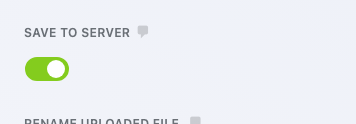
The same field settings include Rename Uploaded File, which lets you build a custom filename out of merge tags, such as a client’s project name and last name, instead of whatever filename the visitor’s browser happened to assign. This applies no matter where the file ends up, Dropbox included, since renaming happens before Ninja Forms routes the file anywhere.

For a client intake form, a rename pattern like the project name paired with the client’s last name turns a folder of generic, browser-assigned filenames into something you can actually find later without opening each one.
With Dropbox connected and the action in place, every new submission’s files start routing there automatically. The remaining question is who else can open them once they arrive.
Who can open a file once it lands in Dropbox
By default, nobody outside your WordPress site can open a Dropbox-delivered file’s link, not even someone who has the link itself. Ninja Forms generates a private link for each uploaded file, and that link only resolves for a logged-in administrator on your own site. Anyone else who clicks it, including the person who submitted the form, will not be able to open it.
That is a safe default, but it is not always what you want. If a client needs to open their own submitted files, or a teammate without a WordPress login needs the link, go to Ninja Forms, then File Uploads, then the External Settings tab, and enable Use Public URL near the bottom of the page. Once enabled, anyone with the link can view the file without logging into your site first.
Your form uploads, off your server and into Dropbox
Connect Dropbox once, add the External File Upload action to any form that needs it, and every submission’s files start routing there automatically instead of piling up on your server. From here, the settings above, keeping a local backup or not, renaming files, opening access to a client, are just fine-tuning around a mechanism that is already doing its job.
Try Ninja Forms Today
Always free, with premium features available through our memberships.